

When to defrag a hard drive, TRIM an SSD and other storage tasks - bennetttommand
We still get quite a couple of questions about when and how to optimize storage devices. Easy answer: The care and eating of storage devices is either taken care of mechanically by Windows, operating theatre it's simply unnecessary. For the most part.
[Have a tech question? Send off your query to answer@pcworld.com .]
Defragging
Defragging hard drives (not SSDs) has been of limited benefit since Microsoft switched to the NTFS file system. Wherefore? Because to a large extent, NTFS is self-optimizing. Lend Windows' various tricks such as pre-bring in, better ordination of files, and hard-wiring important files to set locations, and there's rarely any noticeable degradation in lignified drive carrying into action even later on years of use.
That said, many external drives hail formatted to FAT16, FAT32, or exFAT. These might benefit from optimization after a lengthy period of heavy use. Whether the time you save during standard use after the fact adds adequate the time you drop optimizing the disk drive, or the additional wear and tear on the drive are worth it, are debatable.
Back in the days of FAT, DOS, and slow 80MB hard drives, there was a noticeable uptick in performance after a defrag. Now, non then much. Additionally, the last a couple of iterations of Windows automatically take tutelage of what soft defragging or optimization is required. We suggest you leave it alone.
Should you not take our advice, there's Major caveat—Ne'er defrag an SSD. SSDs puzzle out in an entirely various fashion from hard drives; spreading information over multiple channels to multiple chips. Attempts to defrag do nothing but deplete precious write cycles (sometimes every bit few as 1,000), prematurely aging the SSD.
Checking for errors
 IDG
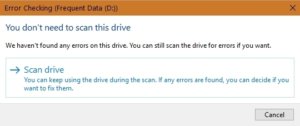
IDG Microsoft is telling the truth, if there's just e'er any need to check for errors anymore. And most of the time information technology's external media that may rich person been abstracted before writes were finished.
The Scan labor command and CHKDSK (the command-line different) are another matter. They are very useful later system crashes, blue screens of death, and the like. So much soh, that Windows in general lets you know when you need to screw. You tail CAT scan or Chkdsk an SSD (right-sink in a drive letter, then selectDrive Properties > Tools > Check), then long As you don't scan sectors, which again, due to the way SSDs run—is nothing but a waste of time and write cycles.
 IDG
IDG Running CMD as administrator, CHKDSK is still a handy way to check drives after a power outage. You can serve the same thing under Drive Properties.
Note: If you run CMD/CHKDSK and you get a permissions error, you'll demand to run CMD as Administrator. Type CMD into the search Windows orbit, then right-sink in connected Command Prompt to reveal that option.
Optimize and TRIM
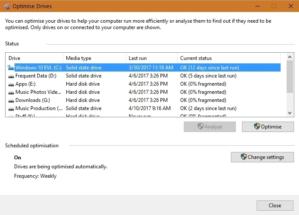
Windows uses Optimizing as a catch-completely phrase to cover both defragging heavily drives and trimming SSDs. The Optimize console is available past right-clicking a drive letter of the alphabet in Windows Explorer, then selecting Properties > Tools > Optimize. With hard drives, Optimize will do a minor defrag Beaver State file organization check; with SSDs IT forces the TRIM command.
 IDG
IDG Windows automatically takes care of optimizing both hard drives and SSDs mostly.
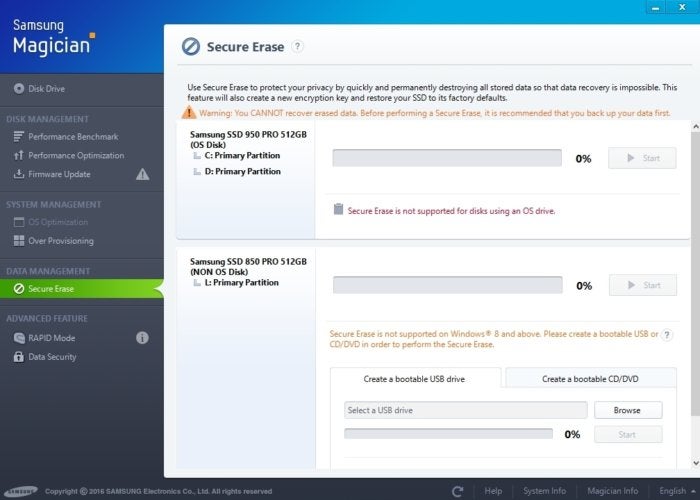
Sending a Tidy command to an SSD simply tells it that it's time to clean house. Normally, you'll only find the command by that name in the utilities that accompany SSDs, such as Samsung's Magician shown below. Trimming erases cells and blocks of NAND that no thirster contain information, and consolidates data into less locations.
Because these trading operations take an eternity in computer terms (anywhere from a couple of seconds to a narrow), they are ofttimes delayed until the drive International Relations and Security Network't busy. Or in many cases, until explicitly invoked via the Clipping command. Forcing TRIM can rejuvenate most of your SSD's missing performance, but if you want all of it…
Secure Erase
For hard drives, impregnable erase is simply a way to efface all the information in a largely unrecoverable manner. That is, not just deleting and creating a new partition, Beaver State reformatting but overwriting previous data. It fire take a real perennial time.
For an SSD, a safety-deposit wipe off deletes all the information, just also zeroes the lookup tables and takes the drive endorse to its virgin, impermissible-of-the-box execution. Oregon at to the lowest degree as more or less IT equally you'll ever get. We ne'er seem to get quite the same numbers game subsequently testing and a secure wipe out, but we bewilder often closer than subsequently a simple TRIM.
 IDG
IDG Samsung's Magician software and its secured delete feature. This erases altogether information on the drive, but can work back the drive's out-of-corner performance. OR almost.
SSDs are generally so fast that you should make out a secure erase only if the drive has been operating close to full electrical capacity for quite a a while, or you're noticing a significant debasement in performance, which is scarce these days.
You'll wish wish to execute a sure erase before you unwrap or deal the drive to make a point the data is recoverable lonesome by the most prohibitively expensive forensic methods.
Final advice
For most users, the Windows Optimize console jell to machine-fly is all that's needed. However, for advanced users, manual TRIM on SSDs and defragging a hard drive in can now and again be recyclable. Just comprise sparing, and in the case of secure delete, make sure you have a recent backup.

Source: https://www.pcworld.com/article/406367/when-to-check-defrag-and-optimize-storage-devices.html
Posted by: bennetttommand.blogspot.com
0 Response to "When to defrag a hard drive, TRIM an SSD and other storage tasks - bennetttommand"
Post a Comment